Wing Chun Kung Fu from a Wheelchair

On our WCO Facebook Page we had several questions regarding Wing Chun, Martial Arts and Self Defense from a Wheelchair. This has been our most widely asked question as few questions were posted on the thread “Hello all Wing Chun Online fans… have a question about Wing Chun or Self Defense? Ask Sifu below…” and several people people private messaged me as well.

Here are some of the questions that were asked:

  • Is there a Martial Arts Form that can be practiced in a Wheelchair?
  • Hi, yes Sifu is there a form or forms in kung-fu for people that use wheelchairs, can master?
  • Can you learn Martial Arts or Self Defense from a Wheelchair?
  • Can you do Wing Chun from a Wheelchair?
  • Thank you to all for visiting Wing Chun Online and here is my two cents…


You can adjust the video quality to 1080p HD…


Where do you put your vision in a fight?

 
fightingResponse to Question: Where do you put your vision in a fight?

Last week on the WCO Facebook page I asked a question, “Where do you put your vision in a fight?”

I greatly appreciate everyone’s response and feedback. There were a plethora of different responses to this one question. As long as you were not guessing, and understand your answer and have tested that it works for you, then you’re correct! My goal is not to insult anyones answer I am simply explaining from my point of view.

It always baffles me when I ask this question to a martial artist and they look at me like they never heard this before. In fighting, the placement of your vision is of the utmost importance. If you understand where to focus, or, more specifically, where to un-focus, you have a much better chance of defending yourself against an attacker.

For those that said you don’t need vision and work off of feel, that is great but contact has to be made first. It is also better that the contact is not someone’s fist in your face. But, yes once contact is made you can work off of feel.

There is another type of feel and that is the ability to get in tune with your opponent and their energy. By doing this you can interpret your attackers intention and actions, although your vision has to be somewhere for this to happen. I will talk more about getting in tune with your opponent’s energy at a later time.

When looking at:

Eyes… Most good fighters do not telegraph their movements with their eyes and they certainly don’t attack with them.

Shoulders… there is something to be said for watching the shoulder as it moves slower than the fist so it definitely works as an early warning indicator, although it does not give any directional information and leaves out the legs.

Centerline… sounds like a guess. Sorry guys ☹ I just don’t see how that would work against a kick.

Here is what I teach my students. Once again I am not saying this is the only answer, simply the one taught by many Wing Chun instructors and the one that best worked for me.

Wing Chun practitioners should look, but not stare. If you use your peripheral vision, you can detect movement more easily and will have a better chance of not getting “faked out” by your opponent. You can simply trust your peripheral vision better than staring at something.

A Wing Chun practitioner places his/her vision on the area around the elbows and knees of his/her opponent, depending on the range. If I am in my opponent’s kicking range I focus more on elbow and knees, as the range shortens my focus can go more towards the elbow.

The purpose of watching the elbows and knees is that they work as an early warning indicator and also relay directional information.

They work as an early warning indicator because the elbow moves more slowly than the fist. In the period of time that a punch is thrown, the elbow moves a shorter distance than the fist in the same time frame; therefore the fist moves at a greater velocity than the elbow. The same applies to the knees and the feet.

The elbows and knees also provide directional information. If you see the elbow lift, a hook punch is most likely to follow. If you see an elbow pull back then possibly the other hand in on it’s way.

Most individuals I show this two come back in awe saying I sparred guys that usually knock me around and had no problem defending myself with this simple little adjustment.

The key to martial arts is to understand the how and why it works then it can work for you!

Here is a simple way to test it for yourself…

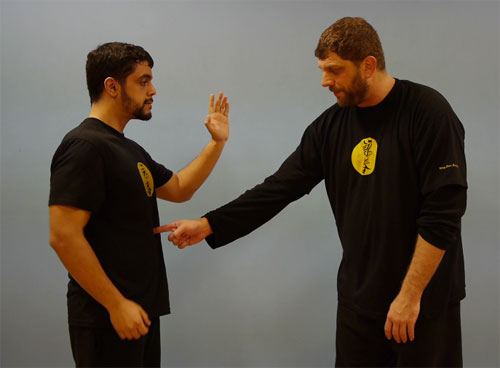
Step 1: Get a partner and have them stand in front of you with their fastest hand up in the air. Tell them that you are going to tap them in the belly no harder than this… and give them a quick light tap. Your not trying to hurt them or hit them hard just a tap will do. Why not a punch? For now this is just a test and should be safe.
fighting vision

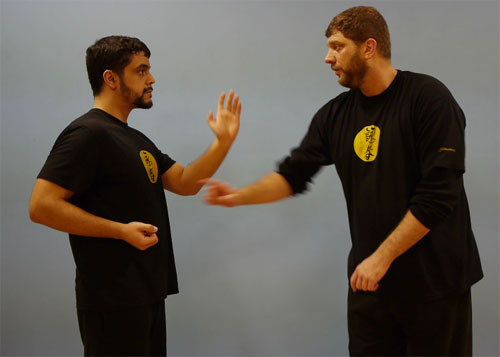
Step 2:  Now have your partner look at your eyes and throw a quick tap. They are going to try to pak, block, swat your hand. What I am getting at is your partner needs no fight or wing chun skills. You can do this with anyone. It is almost better to test his with someone who has had no training as it will be the most honest test.

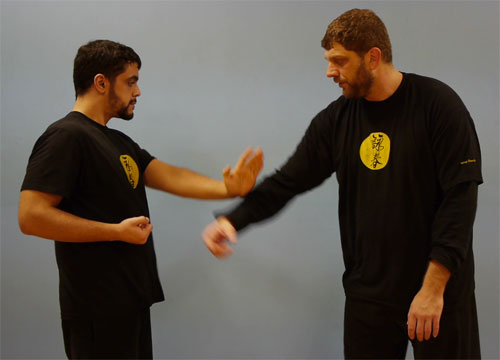
Don’t throw your strike full speed I want you to reserve a little. At half speed you should easily hit them every time without fail. Try it two or three times. In this image below my hand is already on the way back from the strike and his hand is just starting to move.
kung fu test

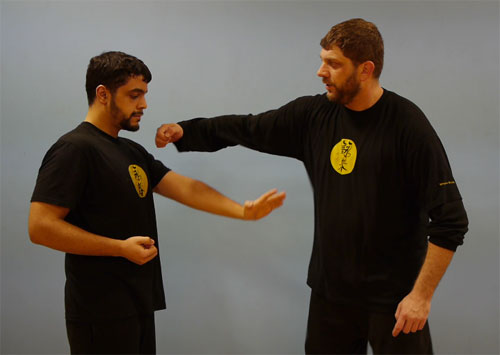
Step 3: Then repeat the same with your partners vision placement this time on your hand. The first time I tapped him in the gut the second time I showed him how simple it is to get faked out by watching my fist.
wing chun theory

Step 4: Now have your partner look at your elbow. They should not stare at your elbow yet simply use their peripheral vision. Tell them as soon as they detect movement they should respond. As you can see below not only did he get it the first time, he got it every time. Do the first punch at the same speed as you did for the eyes and hand, then pick up the speed till you are at full speed. They should still be able to stop it!
wing chun theory

Then have them try it for you. You can try putting your vision where ever you like and see what works the best for you!

Try it out and let leave a comment below to tell us what worked the best for you.

That’s not Wing Chun


Wing Chun Online was created with several intentions in mind. One of them, unite Wing Chun as a whole.
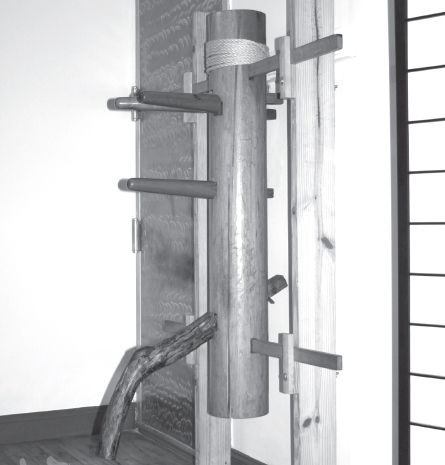
Thanks to the internet there is much exposure and you see numerous variations of the same system.

All too often, beginner students learn Wing Chun one way, and are quick, when observing other systems, to say “that is not wing chun.”

There are numerous variations of Wing Chun, although generally speaking there two main variations of the system that are widely discussed, a traditional and modified version. Even within each variation you will see differences.

Not to get to deep into the history (and this is just one lineage line), at one point the system was modified for a student by master Leung Jan. This student name was Chan Wah-shun and he was Ip Man’s first Wing Chun instructor. Then Ip Man meet Leung Bik, who is Leung Jan’s son and the rest is Wing Chun history. Thus two variations and like my Sifu, Ip Man at one point studied both.

I teach my students to respect all practitioners and arts and encourage all instructors to do the same. I don’t want anyone wasting time over my Sifu is better than your Sifu or modified is better than traditional. Everyone loves their Sifu and thinks their style is the best and that’s great. With over two decades served as a dedicated practitioner of the art of Wing Chun, I assure you, “if it comes from my fists then it’s Wing Chun.” My Kung fu and instruction speaks for itself I would never want a student to waste time defending me.

If you see two people yelling at either from across the street, you don’t know who is right or wrong, they both just look like idiots. That’s not the Wing Chun way.

Spend the time focusing on common ground and learn, grow and evolve. By having an open mind I have learn from traditional and modified masters, as well as other stylists. I was asked to talk and highlight some aspects of the art at a martial arts event at the University of Florida. After the event I approached a escrima grandmaster who also spoke. I was so impressed, and he felt the same about what I shared. We ended up training together numerous times after the event and each of us in our own way got something from training together to enhance our own art.

I feel we all as practitioners of this art should respect each other which shines a brighter light on the art as a whole.

 So dont’ be so quick to say that’s not Wing Chun if it looks different than the style you do. Instead maybe ask why do you do it like that I do it or have seen it done differently? You might learn something.

Check out my Wooden Dummy


Hello fellow martial artists and Wing Chun practitioners.

After posting how to make a wooden dummy on our Facebook page, many practitioners mentioned they made their own wooden dummy.

I know making a wooden dummy is challenging and everyone is proud of their work. Every handmade dummy is not just a Wing Chun or martial arts training tool but a piece of Kung Fu art. Fitting considering the litteral translation of Kung fu is not fighting or martial arts, the litteral translation reflects “Skill achieved through hard work.”

So I thought it would be cool to have a page where everyone can share photos and stories of their dummy and experience making their Mook Jong.

I know some people have made some let’s say less than traditional dummies. I don’t care it will be fun to see everyones Wing Chun Mook Jong or JKD Dummy whether it was perfect or a project, let’s see what you got.

All these were made in the early 90’s

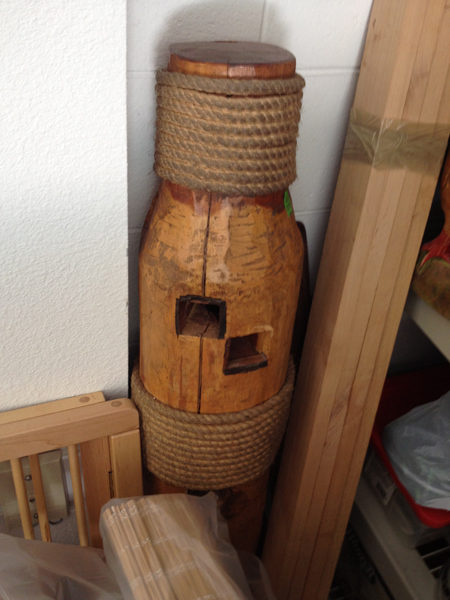
Attempt one let’s call it the protype. This one was very functional but not much of a looker. The goal on this one was to try to get the arms and the leg measurements right,  test getting through the log and making sure the angles were accurate. As we have few wooden dummies in our school, I don’t have a mounted picture. Currently it works as our schools Mook jong, that a student can borrow when in need.

mook jong

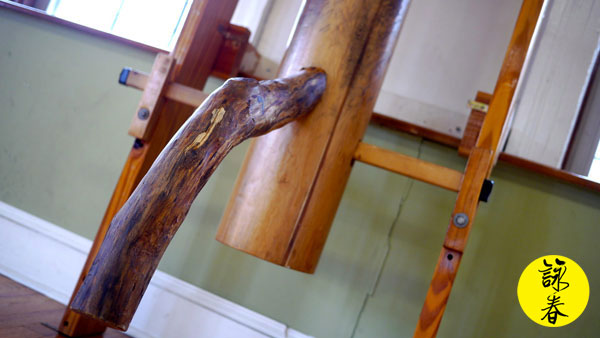
This one below was the second attempt, and the one I still use, and many of my students use daily! Check out the leg. The knee looks like a real knee cap…. I saw this in the woods next to the Kung Fu school in Florida. I knew it would not be easy to get although I had to have it as the limb was a perfect mook jong leg. Since the leg takes a lot of stops over the years I inserted a steel pipe in the leg, few inches above and below where you see the leg sticking out of the front of the dummy. I love this Mook Jong it is more than a piece of training equipment it is part of our schools family.

wooden dummy leg

Below is a great portable dummy my Kung fu brother and I made way back when, since they have been duplicated by many and rightfully so they are great for small spaces. I always will credit my Kung Fu brother Marc for this design as he really was the first to put it together like this.

Send in your photos and story to mydummy@wingchunonline.com (please don’t send images larger than 800 pixels wide)

Stay tuned for more… CHECK OUT MY WOODEN DUMMY!


Wing Chun the Thinking Persons Martial Art

Let’s take a look at the mindset of a Wing Chun Practitioner. Wing Chun is truly a thinking persons martial art. I am talking about the study for now more so than the application. If you are of the analytical mind set then Wing Chun kung fu is a wonderful art to study. If Spock from Star Trek were to study martial arts he would most likely choose Wing Chun as it is the most logical choice.

There is a lot of mystery around Chinese Kung fu, medicine and theory. This can make the study very difficult for those analytical thinkers. As a Doctor of Chinese medicine and a master of Kung Fu, I can assure you I am speaking from experience. In medical school Chinese Theory can be hard to grab as a westerner.

In western medicine you have a headache and the doctor may tell you, take an aspirin. In Chinese medicine the doctor wants to know why. Every patient gets treated as an individual and if ten patients come in with headaches they may each receive a different treatment.

As a kid growing up I was fascinated with Kung Fu. That is all I wanted to do, but I keep running into a whole lot of mystery without explanation. Therefore none of it seemed right or felt like it would work for me. So, I looked into to numerous arts trying to find the solution and when I had my first Wing Chun lesson, I knew right then and there, this is what I had been looking for the whole time.

Wing Chun is different than most arts as it is a true science. Everything is logical and makes perfect sense. There is no mystery or confusion; there is just a clear-cut road map that works.

When a student first comes to watch a class one thing I express is that here I do not want you to have second hand Kung Fu. You are not going to follow me, I am going to show you what, why and how so you fully understand what you are doing and why it works. Otherwise you have second hand training. It may look cool, but probably won’t work when you need it.

The study of Wing Chun is fascinating and enlightening. It is a science in motion and a wonderful art to study for those looking to cut to the chase and truly get what they need.

Stay tuned as later I will discuss the mind set of a practitioner during actual combat.

Wing Chun for Women


kung fuYou may have heard a woman created Wing Chun or Wing Chun is for women. Wing Chun Kung fu is an excellent art for anyone young, old, tall, short, skinny, overweight, male or female.
Five masters created this incredible kung fu style and one of them was a woman. She was a nun and her name was Ngi Mu.

Over 300 years ago five masters had to come together to develop a system of Kung Fu to survive. This martial arts style had to defeat all existing styles of kung fu and martial arts, it had to be learned in a short period of time and it had to not rely on size and strength.

They were basically turned into peasant farmers, they were not well feed, nor were they allowed to train or practice martial arts. So the five masters, in the secrecy of their temple, created this art to teach everyone for survival and to be able to overcome evil and take back control of their lives.

These same concepts hold true today, you cannot defeat a larger, stronger well-trained opponent if you rely on force and have no training. I always assume my attacker is not only trained in combat but also bigger, strong, possibly armed and most likely not be alone. Thus that is what I train and teach to defeat.

Wing Chun works so well for woman because it is an art that has no blocks, does not rely on brute strength, rather works off realistic principles of deflection and redirection. It works with proper body mechanics and technique not physical strength.

With nearly two decades of teaching experience I have trained numerous men and women. Female students do tend to pick up two aspects a little quicker than most male students at the beginning and that is deflection and footwork.

Guys usually have more fighting or martial arts experience so the concept of deflection takes a little longer as they are so used to trying to block and use force. Where women come in with the understanding they cannot beat up big attackers and are looking for something that can do to defend themselves. So once they see the deflection in action it is like a light bulb goes off right away, “sweet that works!”

The footwork in this system is very simple and extremely important. Everyone gets it although some female students grasp the footwork at the begging a little faster, maybe from more dancing and less over thinking. When I show the footwork to a new male student they tend to over think at the beginning, because it is “Kung Fu Footwork” it is harder and there has to be something more to it that I am missing. When I show a new female student the footwork she usually looks at like a dance step and says “that’s easy.”

That is why when a couple comes and wants to join the school to learn kung fu, I look at the guy and say “don’t worry if she gets it quicker than you.” ☺

I had a guy once trying to push my buttons by telling me wing chun is only for women. I got the biggest smile and said, “YUP, if a 90 pound female can kick your ass with it, then image what I can do!”

So is Wing Chun for women, sure, it’s for everyone.

The Amazing Muk Jong of Wing Chun

 
wooden manSIMPLE YET COMPLETE

The Wing Chun training Muk Jong has become well known. You see it in movies about Bruce Lee, in movies done by Jackie Chan and in many others. Even those outside of the Wing Chun system know about the Muk Jong. Many people from styles other than Wing Chun even purchase them. The problem is that most martial artists, even some within the Wing Chun system, don’t understand the Muk Jong. For this reason, they do not get full benefit from it.

The Muk Jong is both incredible and beautiful in its simplicity. The fact that this simple device accomplishes so much is an amazing engineering feat. Once in a while, people will add a leg or some arms, springs, and other whistles and bells in an attempt to invent a new improved Muk Jong. These attempts simply indicate that the person does not understand the classical Muk Jong, (or he or she is primarily looking for a marketing device to set his or her product or organization apart from others). Although some people may think it good business to imply that they have somehow discovered something that others have not, it can be confusing to students new to the Muk Jong. Those who truly understand the Muk Jong realize that it needs no new attachments, batteries or buzzers.

PURPOSE

In Wing Chun, each training exercise has a specific purpose. The forms teach position and movement. The Muk Jong translates the movements within the forms into ‘Root Applications’. This does not mean that there are only 108 applications within the Wing Chun System. It simply means that the movements taught on the dummy are the root or base applications from which all others are derived. Once these are mastered, others grow out of them with relative ease.

DISPELLING MISCONCEPTIONS – NOT A MAKAWARI

One of the greatest misconceptions about the wooden Muk Jong is that it is for toughening your arms. This is pure nonsense. I instruct my students that if they have a question about whether or not they are doing something right (in Wing Chun), they should simply refer back to the core principles of the system. One of the primary principles in Wing Chun is “don’t fight force with force”. In Wing Chun we deflect rather than smash an attacker’s limb out of the way. It is logical then to assume that we would not smash into the arms of the Muk Jong. The object, in fact, is just the opposite. The goal is to work around the arms and find the path of least resistance. Those who smash into the arms are simply displaying a lack of knowledge about both the Muk Jong and about the core principles of the system.

Another misconception is that the Muk Jong is primarily for improving hand positions. Although the Muk Jong does have great value in this area, it has equally important value in training footwork, position, and angle. Students who train the Muk Jong conscientiously will find that their footwork in both Chi Sao and in sparring will be enhanced dramatically.

The Muk Jong, like a form, is a prearranged sequence of movements. It has no specific, separate footwork training exercises. In true Wing Chun form (ref: economy of energy), the footwork exercises are part and parcel to, and contained within the sets themselves. When the footwork is done correctly the hands seem to fall into place easily. If the footwork is incorrect, the hand movements become difficult or impossible.

(NOTE: Wing Chun has a kicking dummy (Star Dummy) used specifically for kicking exercises that I will cover in another article.)

THREE ARMED SPACE MONSTER

Although the Muk Jong has three arms, the three arms do not represent fixed limbs. All three arms can, at times, represent one arm at various positions. The end of the arm(s) represent the elbow, not the hand. The presumed line of energy extends out from the elbow. This is why the arms are so short. As well, the leg represents the active lower limb or the leg in play at that time. A second leg therefore is not necessary (the Jong is not a one legged amputee). In fact it would be an impediment to footwork and movement around the Muk Jong to include a second leg.

HOW MANY MOVES

There has been some disagreement over just how many movements there are on the dummy. Again, in an attempt to create a ‘sales pitch’, there are those who may claim to know extra movements. Classically, the accepted number of movements is 108. In fact this number has more to do with Chinese numerology that it does with an accurate count of the movements. Because of this, debate over the number of movements is really a non-issue.

In Chinese numerology, the number three (and multiples thereof) , as well as the number 108 have spiritual significance. For this reason, you will find that the movements in the Wing Chun forms and on the Muk Jong are contrived to fit into these numbers primarily for their numeric and spiritual significance. It has little to do with the actual number of movements.

MUK JONG CONSTRUCTION

The dimensions of the Jong are not carved in stone. Remember, in days past, there were no facilities for mass production. Each dummy trunk was a little different. The critical factor is in the dimensions and relative spacing of the arms and the construction and pacing of the leg, relative to the arms. Basically, the trunk can be from approximately seven and a half to nine inches in diameter. On a classical Muk Jong, the trunk will be about fifty four inches tall. The arms should protrude approximately twelve inches from the trunk.

SETTING UP YOUR MUK JONG

There is no specific height for the Muk Jong. Just as you wouldn’t use the same settings for every person on an exercise machine the Muk Jong needs to be set differently for people of varying heights. Your Jong should be set up so that the upper arm is at the same height as the crest or top of your shoulder when you are in front of the Muk Jong in a neutral stance.

RESULT

The Muk Jong can help you to vastly improve footwork. It can give you the tools to redirect energy effectively. It can help you develop the skills needed to find the path of least resistance quickly and easily. It will train you to close off all windows of opportunity to your attacker. In short, it can make you a more proficient practitioner and increase your overall skill level, if you know how to use it properly.

If you know how to use the Muk Jong, it can be a great training partner. If you do not, and you choose to buy one, it may become a very expensive coat rack.

Courtesy of Grandmaster Philip Holder