 SIMPLE YET COMPLETE
The Wing Chun training Muk Jong has become well known. You see it in movies about Bruce Lee, in movies done by Jackie Chan and in many others. Even those outside of the Wing Chun system know about the Muk Jong. Many people from styles other than Wing Chun even purchase them. The problem is that most martial artists, even some within the Wing Chun system, don’t understand the Muk Jong. For this reason, they do not get full benefit from it.
The Muk Jong is both incredible and beautiful in its simplicity. The fact that this simple device accomplishes so much is an amazing engineering feat. Once in a while, people will add a leg or some arms, springs, and other whistles and bells in an attempt to invent a new improved Muk Jong. These attempts simply indicate that the person does not understand the classical Muk Jong, (or he or she is primarily looking for a marketing device to set his or her product or organization apart from others). Although some people may think it good business to imply that they have somehow discovered something that others have not, it can be confusing to students new to the Muk Jong. Those who truly understand the Muk Jong realize that it needs no new attachments, batteries or buzzers.
PURPOSE
In Wing Chun, each training exercise has a specific purpose. The forms teach position and movement. The Muk Jong translates the movements within the forms into ‘Root Applications’. This does not mean that there are only 108 applications within the Wing Chun System. It simply means that the movements taught on the dummy are the root or base applications from which all others are derived. Once these are mastered, others grow out of them with relative ease.
DISPELLING MISCONCEPTIONS – NOT A MAKAWARI
One of the greatest misconceptions about the wooden Muk Jong is that it is for toughening your arms. This is pure nonsense. I instruct my students that if they have a question about whether or not they are doing something right (in Wing Chun), they should simply refer back to the core principles of the system. One of the primary principles in Wing Chun is “don’t fight force with force”. In Wing Chun we deflect rather than smash an attacker’s limb out of the way. It is logical then to assume that we would not smash into the arms of the Muk Jong. The object, in fact, is just the opposite. The goal is to work around the arms and find the path of least resistance. Those who smash into the arms are simply displaying a lack of knowledge about both the Muk Jong and about the core principles of the system.
Another misconception is that the Muk Jong is primarily for improving hand positions. Although the Muk Jong does have great value in this area, it has equally important value in training footwork, position, and angle. Students who train the Muk Jong conscientiously will find that their footwork in both Chi Sao and in sparring will be enhanced dramatically.
The Muk Jong, like a form, is a prearranged sequence of movements. It has no specific, separate footwork training exercises. In true Wing Chun form (ref: economy of energy), the footwork exercises are part and parcel to, and contained within the sets themselves. When the footwork is done correctly the hands seem to fall into place easily. If the footwork is incorrect, the hand movements become difficult or impossible.
(NOTE: Wing Chun has a kicking dummy (Star Dummy) used specifically for kicking exercises that I will cover in another article.)
THREE ARMED SPACE MONSTER
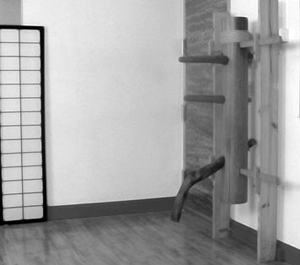
Although the Muk Jong has three arms, the three arms do not represent fixed limbs. All three arms can, at times, represent one arm at various positions. The end of the arm(s) represent the elbow, not the hand. The presumed line of energy extends out from the elbow. This is why the arms are so short. As well, the leg represents the active lower limb or the leg in play at that time. A second leg therefore is not necessary (the Jong is not a one legged amputee). In fact it would be an impediment to footwork and movement around the Muk Jong to include a second leg.
HOW MANY MOVES
There has been some disagreement over just how many movements there are on the dummy. Again, in an attempt to create a ‘sales pitch’, there are those who may claim to know extra movements. Classically, the accepted number of movements is 108. In fact this number has more to do with Chinese numerology that it does with an accurate count of the movements. Because of this, debate over the number of movements is really a non-issue.
In Chinese numerology, the number three (and multiples thereof) , as well as the number 108 have spiritual significance. For this reason, you will find that the movements in the Wing Chun forms and on the Muk Jong are contrived to fit into these numbers primarily for their numeric and spiritual significance. It has little to do with the actual number of movements.
MUK JONG CONSTRUCTION
The dimensions of the Jong are not carved in stone. Remember, in days past, there were no facilities for mass production. Each dummy trunk was a little different. The critical factor is in the dimensions and relative spacing of the arms and the construction and pacing of the leg, relative to the arms. Basically, the trunk can be from approximately seven and a half to nine inches in diameter. On a classical Muk Jong, the trunk will be about fifty four inches tall. The arms should protrude approximately twelve inches from the trunk.
SETTING UP YOUR MUK JONG
There is no specific height for the Muk Jong. Just as you wouldn’t use the same settings for every person on an exercise machine the Muk Jong needs to be set differently for people of varying heights. Your Jong should be set up so that the upper arm is at the same height as the crest or top of your shoulder when you are in front of the Muk Jong in a neutral stance.
RESULT
The Muk Jong can help you to vastly improve footwork. It can give you the tools to redirect energy effectively. It can help you develop the skills needed to find the path of least resistance quickly and easily. It will train you to close off all windows of opportunity to your attacker. In short, it can make you a more proficient practitioner and increase your overall skill level, if you know how to use it properly.
If you know how to use the Muk Jong, it can be a great training partner. If you do not, and you choose to buy one, it may become a very expensive coat rack.
Courtesy of Grandmaster Philip Holder

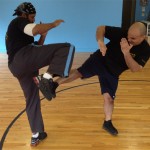
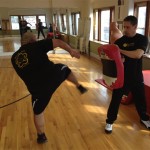
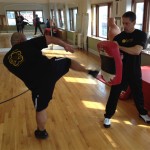
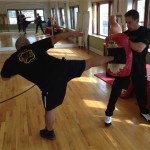
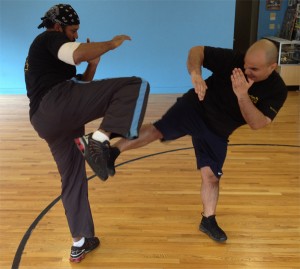 I have been training Wing Chun and teaching for numerous years and I often hear this… “I heard Wing Chun guys don’t kick”. I always get a smile when I hear that. I have also heard after sparring other martial artist from different styles, “I thought Wing Chun guys don’t kick, you kicked the crap out of me”. Basically practitioners got the reputation of not being kickers simple because we do not use fancy kicks. We use effective kicks. Now don’t get me wrong any good kick upside the head can do major damage.